Compare · Atlas Public vs. Krinkle Debris Tracker

Atlas Public vs. Krinkle Debris Tracker: a cost and capability comparison for monitoring firms.

What you actually pay, how tickets are protected, and what each platform is built on — sourced strictly from Krinkle's published page and Atlas's own materials. No invented competitor claims.

See the full Atlas Public rate card
Atlas DMS — figure carrying the world
The short version

The differences that matter are the ones you can check before a sales call.

Atlas Public and Krinkle Debris Tracker both run ROW and public-facilities debris monitoring. The differences that matter are things you can check before a sales call: what you pay, how tickets are protected, and what you're built on.

Krinkle bills $2.50 for every project hour billed to the client — field staff plus project managers, office leadership, and executives — runs on pre-printed paper tickets sold at $350 per thousand, and treats data integrity as something you detect in reports after the fact. Atlas Public bills only field-staff hours on a lower graduated rate ($1.50 down to $0.75), is fully paperless, and prevents a non-compliant ticket from being created in the first place through four-factor authentication. It's also built to current FEMA guidance (PAPPG v5 and the FEMA Debris Monitoring Guide), by someone who has worked every role in a debris operation — from driving the haul truck to running the debris monitoring program.

What you actually pay

Field-staff hours, on a graduated rate.

Krinkle's published model charges for every hour billed to the jurisdiction. Atlas Public charges only for field operation hours — monitors, field supervisors, and operations managers. Project management, data management, and leadership hours are never metered.

Atlas Public rate (graduated tiers — each band billed at its own rate)

Total billed field hours Rate for that band
First 20,000 $1.50 / hr
20,001 – 50,000 $1.25 / hr
50,001 – 100,000 $1.00 / hr
100,001 – 150,000 $0.85 / hr
150,001 and above $0.75 / hr

Cost comparison on identical billed field hours

Field hours Atlas Public Krinkle ($2.50 / billed hr) You save % lower
20,000 $30,000 $50,000 $20,000 40%
50,000 $67,500 $125,000 $57,500 46%
100,000 $117,500 $250,000 $132,500 53%
150,000 $160,000 $375,000 $215,000 57%
200,000 $197,500 $500,000 $302,500 61%
300,000 $272,500 $750,000 $477,500 64%

Three things make the real-world gap larger than this table:

Prevention, not just detection

The difference that protects your contract.

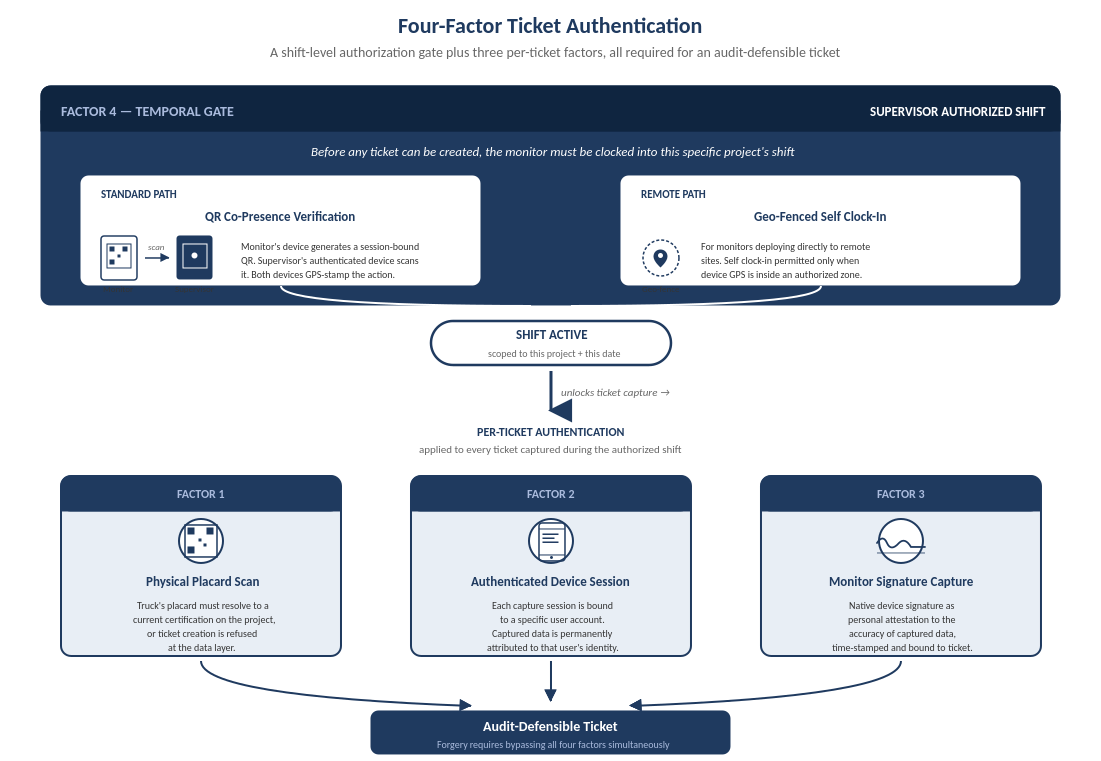
Krinkle's published approach to integrity is fraud-detection reporting — surfacing issues in reports after tickets are captured. Atlas Public takes a prevention-first approach: a non-compliant ticket can't be created in the first place. Every Atlas ticket must clear four authentication factors before it exists as a record.

Atlas four-factor ticket authentication: supervisor-authorized shift gate plus physical placard scan, authenticated device session, and monitor signature capture, producing an audit-defensible ticket.
Four authentication factors must all pass before a ticket exists as a record.

The result is an audit-defensible ticket: forging one means defeating all four factors simultaneously. For a firm whose reputation and contract performance ride on every ticket surviving a FEMA audit, preventing the bad ticket at the point of capture is a fundamentally stronger position than detecting anomalies in a report afterward.

Reconciliation

Validating the contractor's own invoice.

Atlas Public is fully paperless and extends access to the people who do the hauling. Debris removal contractors and their drivers get their own login to view their reports and metrics, download ticket data, and download invoice data.

When it's time to get paid, a contractor prepares its invoice on its own letterhead and template, and Atlas reconciles that invoice against the captured system of record to surface any discrepancies. When it reconciles cleanly, Atlas generates a reconciliation report and a letter of recommendation for payment for the government/applicant client. That independent validation step — checking an independently-prepared invoice against an independent record before money moves — is what stands up when an auditor asks how a payment was justified.

Built to current FEMA guidance

Designed around PAPPG v5 and the current Debris Monitoring Guide.

Atlas Public is designed around PAPPG Version 5 (effective for incidents declared on or after January 6, 2025) and the current FEMA Debris Monitoring Guide. Krinkle's published page still references FEMA-325, the Public Assistance Debris Management Guide that FEMA superseded in 2016. Building to the standard your reimbursement is actually evaluated against is not a small thing in an audit.

Your brand, not ours

Atlas Public is white-label.

Your team and your jurisdiction clients work inside your own branded environment and see your name. Krinkle does not offer white-label branding; it is delivered as a Krinkle product.

Built by someone who has done every job

The credibility behind a newer platform.

Atlas's designer spent 21 years in debris operations — and on both sides of the ticket. He drove a haul truck after Katrina, and during Hurricane Irma worked as a data analyst for a major debris removal contractor across Florida and Puerto Rico. On the monitoring side, he had already come up through monitor, field supervisor, operations manager, and data manager to project manager by then, and went on to regional manager and program director. He has seen the ticket from inside the truck cab and from the reconciliation desk. Krinkle's forms were built in cooperation with subject-matter experts; Atlas was built by one.

Side-by-side

Every claim on this page, in one table.

  Atlas Public Krinkle Debris Tracker
Billing basis Field-staff hours only Every project hour billed to client
Rate $1.50 → $0.75 graduated $2.50 / hr
Setup fee None $2,500 one-time
Tenant access Self-service — create, configure, and manage projects, demos, and test environments at will $2,500 setup incl. 8 hrs training (per their page)
Paper-ticket cost None — paperless Pre-printed tickets, $350 / thousand
Ticket medium Fully digital (load + disposal) Pre-printed barcoded paper tickets
Data integrity Prevention — four-factor authentication at capture Fraud-detection reporting
Invoice handling Validates the contractor's own invoice; issues payment-recommendation letter Captures contract terms; generates an invoice
Built to current FEMA guidance PAPPG v5 + Debris Monitoring Guide Page cites FEMA-325 (superseded 2016) + PAPPG
White-label under your brand Yes No
ROW / public facilities Yes — Atlas Public Yes
PPDR / wildfire Yes — Atlas Foundation Yes — multi-year field record
Dedicated waterway module Atlas Channel (in production) Not advertised as a dedicated module
Who should choose which

Two honest defaults.

Choose Krinkle if a long, in-production field record is your single deciding factor — especially for wildfire work you need running today.

Choose Atlas Public if you want a materially lower and more honest cost basis (field hours only, no paper), tickets that are protected at the point of capture rather than audited after the fact, software built to the FEMA guidance your reimbursement is actually judged against, a platform under your own brand, and a system designed by someone who has worked every seat in the operation.

Next step

See the rate card, or walk the platform.

Half-hour demo on your real operation. No pressure, and no sales-call qualification gate.

See the full Atlas Public rate card